
What exactly is the difference between NPT, BSP and G thread standards?
The most easily overlooked ‘pitfall’ in selecting valves and fittings
In many customer enquiries, we frequently encounter situations like this:
“I need a ball valve with female threads at both ends.”
“Right, what thread standard would you like?”
“Just a standard thread—the same as on a water pipe.”
This sort of conversation takes place almost every week. Choosing the wrong thread standard is one of the most common and costly issues in valve procurement. If the valve cannot be fitted after purchase, or if it is fitted but fails to seal properly, leading to leaks, the consequences range from minor delays to the need to rework the entire system.
Today, in this short article, we’ll clarify once and for all the three most commonly confused thread standards: NPT, BSP and G.、、
I. Let us begin with the most fundamental difference: one is a ‘cone’, the other a ‘cylinder’.
This forms the basis for understanding all the other differences.
Thread type|
Thread type |
Full name |
Lead angle |
Structure |
Sealing method |
|
NPT |
American National Tapered Pipe Thread |
60° |
Tapered thread (1:16 taper) |
Sealed by the thread itself |
|
BSPT (part of the BSP series) |
British Standard Tapered Pipe Thread |
55° |
Tapered thread (1:16 taper) |
Sealed by the thread itself |
|
G (part of the BSP series) |
British Standard Prismatic Pipe Thread (BSPP) |
55° |
Cylindrical thread (no taper) |
Sealed by the end face or a gasket |
|
BSP |
British Standard Pipe Thread (collectively) |
— |
Includes BSPT (tapered) and BSPP (cylindrical) |
Depends on the specific type |
In a nutshell:
NPT = American standard tapered thread
BSPT = British standard tapered thread
G thread (BSPP) = British standard parallel thread
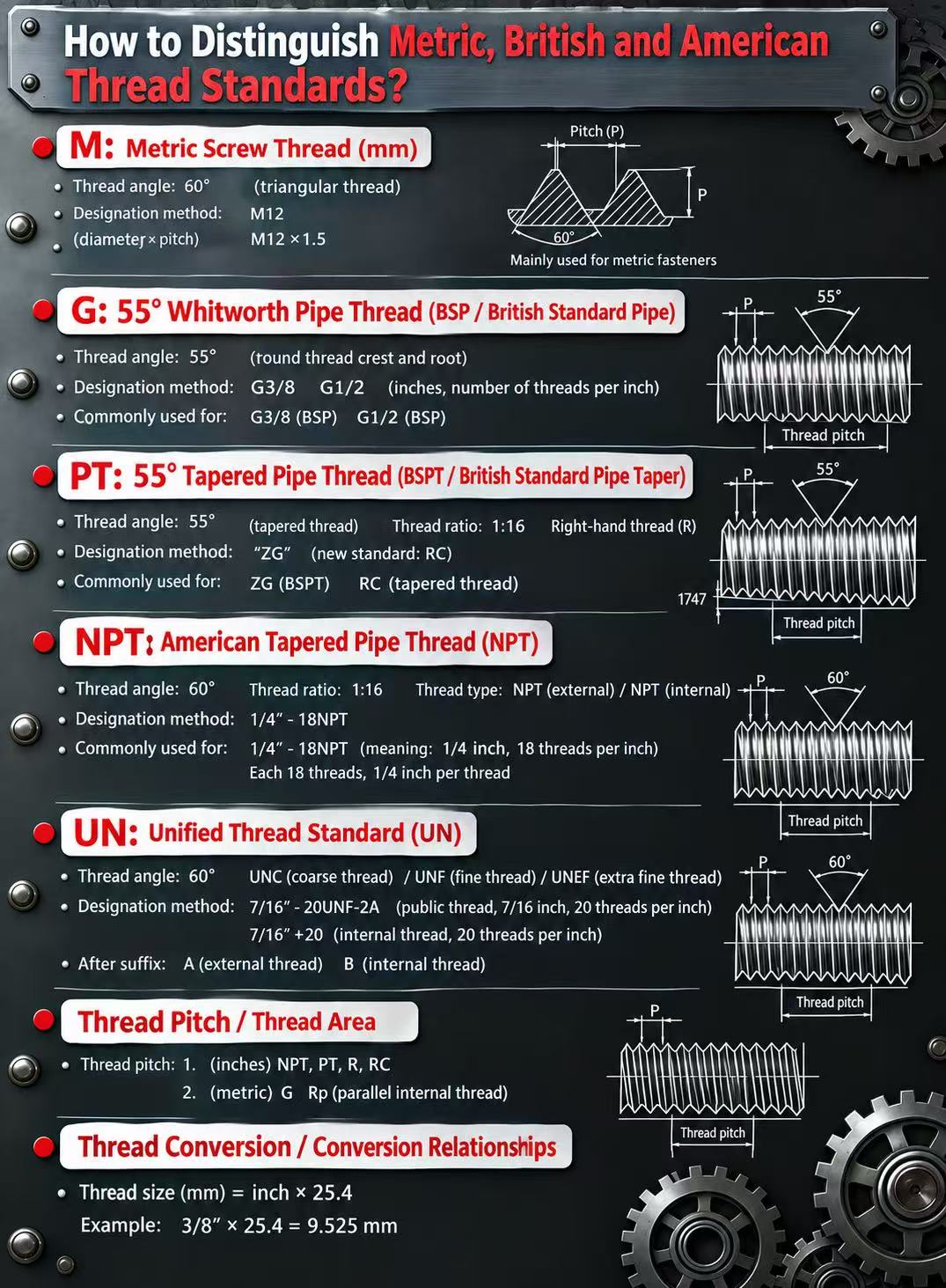
Both NPT and BSPT are tapered threads with the same taper ratio (1:16), but they differ in thread angle (NPT is 60°, whilst BSPT is 55°).
II. A Detailed Breakdown: What Are NPT, BSP and G?
1. NPT Threads (American Standard)
Standard Number: ASME B1.20.1
Characteristics: 60° thread angle, 1:16 taper
Sealing principle: Sealing is achieved through the interference fit of the threads themselves; no sealing gasket is required
Common regions: The United States, Canada and other countries following the American standard system
Common ball valve specifications: 1/4‘ NPT, 3/8’ NPT, 1/2" NPT
Note: NPT threads require the application of PTFE tape or thread sealant; torque control is crucial during assembly, as over-tightening can cause the female thread to split.
2. BSP threads (British Standard)
BSP is a general term that encompasses two types, which many people tend to confuse:
BS 2779 / ISO 228-1
This is where the biggest misconception lies: many people assume that ‘BSP threads are the same as G threads’, but this is not entirely correct. G threads are a type of BSP, but BSP also includes BSPT. G threads are cylindrical, whilst BSPT threads are tapered; the sealing principles behind the two are completely different, and they must not be used interchangeably.
BSPT (British Standard Pipe Thread)
G thread / BSPP (British Standard Pipe Thread)
Standard Number
BS 21
Thread Angle
55°
55°
Construction
Tapered thread (1:16 taper)
Cylindrical thread (non-tapered)
Sealing Method
Self-sealing (requires Teflon tape)
Sealed by a face seal (e.g. O-ring, flat washer, brass washer)
Common Applications
Commonwealth countries, Europe and parts of Asia
Used worldwide, particularly in Europe and Asia
Common Ball Valve Sizes
1/4"BSPT、3/8"BSPT、1/2"BSPT
G1/4、G3/8、G1/2
III. A single table to understand all the differences
|
Comparison Criteria |
NPT |
BSPT |
G (BSPP) |
|
Standard System |
American standard |
British Standard |
British Standard (Internationally recognised) |
|
Tooth Profile |
60° |
55° |
55° |
|
Structure |
Tapered thread |
Tapered thread |
Cylindrical thread |
| Taper | 1:16 | 1:16 |
None |
|
Sealing Method |
Thread seal (wrapped with Teflon tape) |
Thread seal (with Teflon tape) |
Face seal (gasket/O-ring) |
|
The‘/ in the code |
e.g. 1/2" NPT |
e.g. 1/2" BSPT |
e.g. G1/2 |
|
Arethey interchangeable? |
Not interchangeable with BSP |
Not interchangeable with NPT |
Not interchangeable with BSPT |
IV. How can you quickly tell the difference in practice?
If you have a sample in your hand without a label, you can identify it as follows:
Method 1: Check the thread profile (requires a thread gauge or thread tester)
60° thread profile → NPT
55° thread profile → BSP series (G or BSPT)
Method 2: Check the sealing structure
Threads require Teflon tape or sealant → NPT or BSPT (tapered threads)
Requires a flat washer, O-ring or brass washer → G thread (cylindrical threads)
Method 3: Count the number of threads (quick estimation method)
For the same nominal size, the number of threads per inch differs between NPT and BSP. For example, 1/2":
NPT: 14 threads per inch
BSP (G/BSPT): 14 threads per inch (this size is identical for both, making them easier to confuse)
However, for 3/4": NPT has 14 threads and BSP has 14 threads (still identical)
The true distinction lies in the thread angle and taper, which are difficult to discern with the naked eye; the most reliable method is to use a thread gauge.
Method 4: Check the country of origin or customer requirements
If the customer is based in the US and the drawings specify ASME → NPT
If the customer is based in Europe or the Commonwealth and the drawings specify BS or ISO → BSP
If the drawings specify ‘G’ followed by a number (e.g. G1/2) → cylindrical thread; a washer is required
V. What happens if the wrong choice is made? (Real-life cases)
Case 1: A certain equipment manufacturer procured a batch of ball valves with G1/2 internal threads, but the external threads on the customer’s pipework were NPT 1/2. A worker attempted to screw the valve on by force for four turns but could not turn it any further; upon applying further force with a spanner, the valve body’s threads split, rendering the entire batch of valves unusable.
Case 2: A laboratory fitted a ball valve with a BSPT external thread to a fitting with a G internal thread. It felt ‘about right’ when screwed on, but a pressure test revealed a slight leak. It took three days of investigation to discover that the threads were incompatible—a tapered thread had been screwed into a cylindrical internal thread, with only the first few threads making contact, resulting in an insufficient sealing surface.
Lesson: When it comes to thread mismatches, there is no such thing as ‘close enough’. A difference of just 1° in the thread angle is the difference between being unable to fit the component and being unable to achieve a seal.
VI. Final Recommendations for Purchasing Staff and Engineers
Before placing an order, please ensure you have confirmed the following three details:
Thread standard (NPT or BSP/G?)
Thread type (tapered or cylindrical?)
Thread size (e.g. 1/4‘, 3/8’, 1/2")
Ensure that dimensions on drawings are specified correctly:
US standard: write 1/2-14 NPT
British tapered standard: write 1/2 BSPT
British parallel standard: write G1/2 or 1/2 BSPP
Unsure about your pipe thread specifications? We’re here to help you verify them.
Thread matching is the most fundamental—and most prone to errors—aspect of a pipework system. A single mistake in the thread standard could result in an entire batch of valves being unusable, or even lead to leaks and the need for rework across the entire pipework system.
If you happen to have samples such as ball valves, pipe fittings or connectors, or if you have a photograph of a thread and are unsure of the standard—please feel free to send them to us at any time, and we’ll verify them for you free of charge.
We do not make ‘rough estimates’; we cross-reference against standards and take actual measurements using thread gauges to provide you with a precise answer.
How to confirm:
Take a clear photograph of the threaded end face and send it to us.
It is even more convenient if you have a physical sample, as we can measure it directly using a thread gauge.
You can contact us via WeChat, telephone or email (contact details): clvy@shenchihb.com
Thread types we can supply:
Our ball valves and pipe fittings can be customised to meet a variety of thread standards, including NPT, BSPT and G (BSPP), ensuring a 100 per cent match with your pipework system. Whether for the domestic market or for export, we can manufacture to your drawings.
Choose the right thread and avoid unnecessary complications. If you’re unsure, leave it to us to confirm.
Related News
- Shenchi Launches New Product | Press-fit Mini Ball Valve: Compact Structure, Ample Potential
- Why Are Kitchen Faucets Essential for Creating a Modern, Efficient, and Stylish Kitchen
- Why Is Double-Press Equal Coupling Essential for Modern Mechanical Systems
- Why Should You Choose a Gooseneck Brushed Mixer Kitchen Faucet for Your Modern Kitchen
- What Makes the Gooseneck Brushed Mixer Kitchen Faucet a Must-Have for Your Kitchen
- What is a Double-Press Female Threaded Adapter and Why Should You Choose It
Leave me a message